
The book “Home Away From Home… History of Ogbomoso People in Jos,” published in 2012, was written by Olayinka Oyegbile PhD. The book did a fantastic job of chronicling the incredible story of how Ogbomoso people found a second home in Jos.
It documents, in vivid detail, the attribute of an average Ogbomoso man: easily lured by commerce, and wherever trade flourishes, there you’ll find him. Fearless and adventurous, he could trek if need be, to establish and start a business anywhere it can thrive.
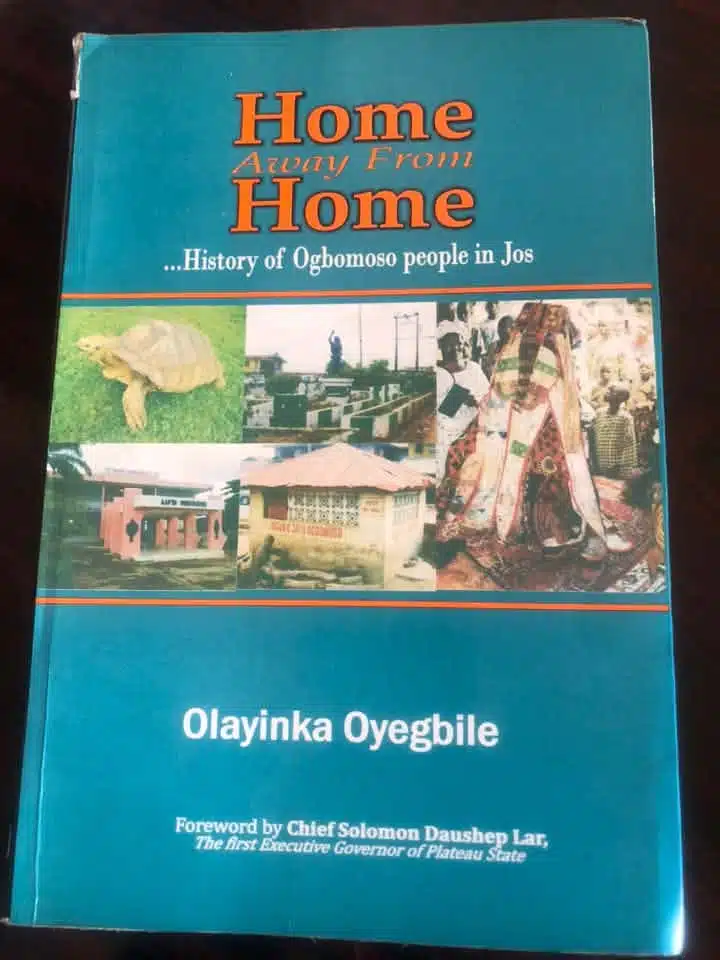
In the book, it is established that Ogbomoso people were among the earliest settlers in Jos arriving as early as in the 1880s. The discovery of tin was the nectar that drew more Ogbomoso people there, invited by relatives already settled, not as labourers in the mining sites, but as traders selling wares ranging from kolanut to cloth and other sundry articles.
The book also gives a glimpse into the business acumen and ingenuity of the Ogbomoso people, dedicating a chapter to the Ogbomoso Trade Moguls, documenting the exploits of great sons of the soil such as Prince J.O. Oyewumi, who later became the Soun of Ogbomoso in 1973, Chief David Oyediran Olagbemiro, Pa Moses Akande Onigbinde, and Alhaji Y.A. Ishola, to name a few.
One of the things I love about the book is how it addresses the persistent indigeneship issue, the controversy over ownership of the Tin City.
Oyegbile, who grew up in Jos himself as a Yoruba Christian boy, has spoken about a Jos where ethnicity and religion simply didn’t matter, where children moved freely between churches and mosques and were judged by character alone.
The author traces how that harmony began to erode from the 1990s, as divisive politics took hold, and how the question of who is truly an “indigene” versus a “settler” became one of the most explosive fault lines in the crises that followed, even for families who had lived and paid taxes in Jos for decades.
The book gives a powerful insight into how language becomes a tool of domination, he also documented firsthand accounts from those who lived through the violence and crisis.
For me, the icing on the cake is that Chief (Dr.) Solomon Daushep Lar (C.O.N), the first Executive Governor of Plateau State, wrote the foreword. In it, he affirms that Jos is home to Ogbomoso people, citing notable Jos-bred Ogbomoso individuals who excelled meritoriously in the military, business, the state judiciary, and the state civil service.
Two years ago, my good friend Àyánkọ́lá Àyánwuyì and I began working on a documentary titled “A Road From Ògbómọ̀ṣọ́ to Jos.” It tells the beautiful story of how Ògbómọ̀ṣọ́ people found a second home in Jos. We will hold private screenings of the documentary in Ògbómọ̀ṣọ́ and Jos in the first week of September.
This book was very helpful while working on the documentary, and Àyánkọ́lá and I are deeply grateful to Olayinka Oyegbile PhD for writing it. It served as a foundation we could comfortably build on.
I must also commend the author’s brother, Timothy Oyegbile Esq., for granting us access to the book, encouraging and supporting us throughout the project, and even featuring in the documentary. Thank you so much, sir.
Business Email — hello@johnsonokunadea.com