Across the world, there are people who have not been swayed by the technological advancement but have rather maintained their traditional way of life.
Some of this kind of people are found around Lake Turkana and the Lower Omo Valley in Southern Ethiopia.
The Surma people is made up of three ethnic groups:
The Mursi People
The Suri People
The Mekan people
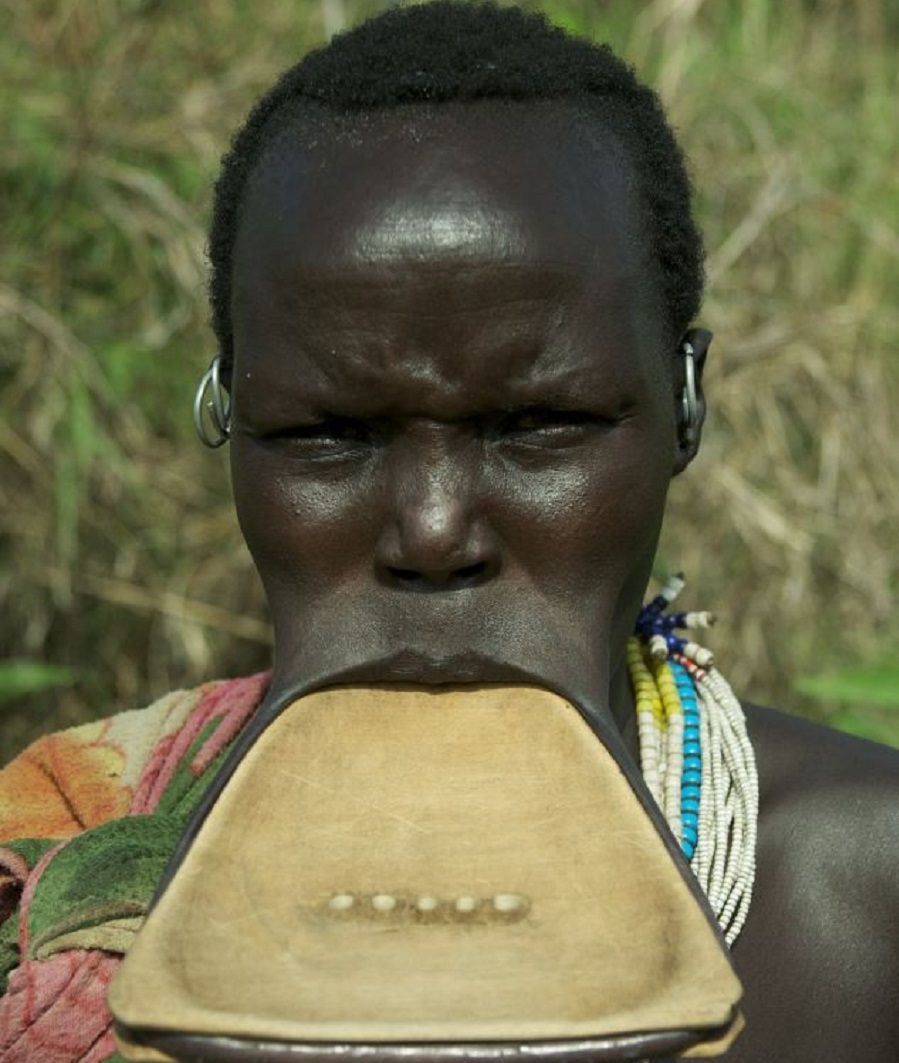
The Suri and the Mursi share a similar culture. Their women’s beauty is determined by how large their lip plate is.
Lip plates are usually made of clay or wood and range between 4 and 25 centimeters. To be placed on the lip, two or four teeth are removed before the lower lip is cut to fit the lip plate.
This lip plate process is usually done by their mother when they attain puberty. To stretch the lip, a ceramic disc is placed after the cut and will remain until the initial cut has healed before it is placed with another slightly larger disc.
The process is repeated so that the lip will become large enough to accommodate the first lip plate which is about 4 centimeters. Beauty is in the eye of the beholder.
Apart from designing their skin with incisions and patterns which are sometimes painted, the lip plate is seen as a boost of one’s self -esteem.
The lip plate tradition is valued by both parents because it indirectly means that the father ’s number of cows will increase when he is paid her dowry. Any man who must marry a Suri or Mursi lady has to be wealthy because her dowry usually falls between 40 cattle (for the small plate) and 60 for the large plate).
Because of the self -worth and importance attached to it, some girls increase their lip plate. To their delight, they are often allowed to design her lip plate.
Most times, the women don the lip plate when their intention is to look more appealing . An example is when they want to serve the meal of their male counterpart; as part of their beauty regime or during special ceremonies.
However, their men only have to undergo body painting as their form of ritual. Each scar on the man tells a story: He has fought and killed an enemy .
What a proud people !
What do you think about them?
The BEST way to support us is by providing funding to enable us continue this good work:
Bank: Guarantee Trust Bank (GTBank)
Account Name: Johnson Okunade
Naira Account: 0802091793
Dollar Account: 0802091803
Pounds Account: 0802091810
Euro Account: 0802091827
When I was in primary school, I and my friends used to envy the King’s tortoise that had its own car, house, and servants, ate whatever it liked and enjoyed life to the fullest.
I could remember one of my friends saying the king must do whatever the tortoise commands. The most gullible thought and fantasy we had about Alagba, King Soun’s tortoise was that it could talk.
Mr Ajamu Oluwatoyin, the secretary to Oba (DR) Oladunni Oyewunmi, Soun of Ogbomosoland, hosted me inside his office in December 2017 at the Soun’s Palace, told me all about Alagba and answered all the questions I asked about the world’s oldest animal.
The Genesis
Kumoyede Ajao who was the third Soun of Ogbomosoland, dated back to the 16th century. Kumoyede was the son of Jogioro, a famous, strong and brave man who sought and brought respectability to the leadership of the Souns family. It was through Kumoyede that the Soun dynasty had become firmly established in Ogbomosoland.
During the reign of Jogioro, it was believed that Kumoyede, a passionate and charismatic hunter was hunting in the bush one day. While hunting, instead of finding animals, he found a little tortoise under the leaves. He then decided to bring the tortoise to the palace.
Kumaoyede Ajao, then a prince started taking care of the tortoise and people started calling the tortoise “Ijapa Kumoyede” (Kumoyede’s tortoise).
When Kumoyede succeeded his father, Jogioro, they started calling the tortoise: “Ijapa Oba” (the king’s tortoise). After Oba Kumoyede Ajao died, his son who was the “Aare Ona-kakanfo” (the Yoruba nation generalissimo), Baale Toyeje Akanni succeeded him and inherited the tortoise.
Since then, the tortoise was inherited by 18 Souns of Ogbomosoland until its death in 2019.
Things To Know About Alagba
The tortoise was named Alagba which means “the elderly one” in Yoruba as a sign of respect because the tortoise was acclaimed to be the oldest in Ogbomosoland.
On my visit to the Palace, the tortoise refused to show any sign that he noticed me when I called it “ijapa” which is the Yoruba name for tortoise.
In fact, it was prepared to retreat back into its shell. But to my surprise, it stretched out its neck full of age, spots and thick rough warts, slowly opened its eyes and looked at me when I called it Alagba.
Alagba used to eat food but preferred fruits more than food, especially pawpaw and bananas. The Tortoise used to drink water fortnightly and when it does, finishes a 25-litre bucket full of water. It also detested heat and plays a lot in the rainy season
When talking to Alabi, one of those taking care of the tortoise, he said I can try carrying the tortoise and see what will happen. Curious to find out, I tried carrying the tortoise with all my strength but the tortoise wouldn’t even bulge. Alabi then told me that the tortoise weighed 100kg, “Alagba’s weight is equivalent to two bags of cement” Alabi said.
No matter how heavy you are, Alagba will carry you on its back and move about, but Oba Oladunni Oyewumi who cares so much about the well-being of the Alagba stopped this.
The king also respected Alagba, he used to pay him a visit whenever he was coming back from an outing or strolling around the palace.
Whatever might have been anybody’s offence to the king, the Kabiyesi overlooks it if such a person had run to Alagba for protection. Alagba was the only being the king’s wives run to for refuge to avoid the king’s anger.
Alleged Myths and Legends
Like some items in African traditional palaces, Alagba has been alleged to exist for mystical and spiritual purposes like some items found in African traditional palaces.
When speaking with Mr Ajamu Oluwatoyin about this in his office, he said Alagba is just a mere tortoise that God blessed with age, he continued by saying Alagba was never treated as sacred. “In fact, the tortoise eats food remnants from the palace.
He further said that some people believe the tortoise is immortal. However, in 2008, the tortoise fell sick and suddenly developed a lump on the right side of its mouth.
The king, HRM Late Oba Dr Oladunni Oyewumi was duly informed and he ordered that the tortoise be referred to the Veterinary hospital in Mokola, Ibadan for medical attention.
They later called the king from the hospital that it was a sign of old age. The veterinary doctor said they had to carry out surgery on the tortoise but the king decided to avoid the operation and ordered that the tortoise returned to the palace where it recovered by itself.
With this, he concluded by saying that it was proof that the tortoise is not immortal and it can die at any time.
Some Other Alleged Myths Include:
It was a particular king who had become so old that turned himself into a tortoise during a festival in the palace.
Some claim that the tortoise can talk. Although it is generally known that the tortoise could hear what people say. This was evident in the way he responded when I called it Alagba.
Some people believe Alagba is a deity of longevity so they stay near Alagba to offer prayers of longevity.
Some people claim that the tortoise is a deity that is being worshipped. Mr Ajamu Oluwatoyin however, debunked this claim saying there was never a time Alagba was worshipped as a deity, the king only refers to it whenever there is a celebration in the palace in recognition of past Obas.
Some people used to buy bananas and eat them with the tortoise believing it was a blessing
Some people also claim that the tortoise has a lot of connection with every Soun that had ruled, rules, and will rule Ogbomoso land.
Finally, they believe that the tortoise must not die because if it does die, there will be consequences afterwards.
Late Oba (DR) Oladunni Oyewunmi and Alagba
Alagba: The Oldest Tortoise That Ever Lived on Earth
Tortoises generally live longer than other animals and this is possible because of their link with the dinosaurs.
Tortoises and turtles belong to the order Chelonians and they are the only living representatives of the order Chelonians which have a close link to the dinosaurs which are ancient animals that lived for very long – up to 400 years – and had enormous sizes.
Most tortoises do not pass 100, some have been known to live well past that marker and have lived as long as 200 to 250 years.
The ability of tortoises to live so long has a lot to do with how they are built and how they live because they are protected by a strong hard shell.
Tortoises are good at avoiding predators and also live and move slowly, which means they use up less energy than lots of other creatures.
If a tortoise is unable to find enough food, they can survive for a longer period more easily than animals who burn through their energy really quickly.
Addwaitya, the giant tortoise, is reckoned to have been 255 when it died at an Indian zoo in 2006, making him the oldest animal in the world.
The previous oldest tortoise was widely thought to be Harriet, a giant Galapagos land tortoise that died in 2005 at age 175 in Australia. Despite its old age, locals say it still has the energy to regularly mate with the three younger females.
In March 2006, it was reported that an Aldabra tortoise at the Calcutta Zoo died and was estimated to be 250 years old.
A Madagascar radiated tortoise was said to have lived in captivity for at least 188 years. Similarly, a 176-year-old giant tortoise from an Australian Zoo died in June 2006. Typically, the Galapagos tortoise lives 150 years. Other varieties regularly live to be 100.
At the moment a Seychelles giant tortoise named Jonathan, whose age is about 184 years, is believed to be the oldest known living reptile on earth.
Jonathan was photographed during the Boer War around 1900, and the tortoise’s life has spanned eight British monarchs from George IV to Elizabeth II and 50 prime ministers. It was taken on the South Atlantic island of St Helena, where Jonathan still lives today, along with five other tortoises David, Speedy, Emma, Fredricka and Myrtle, in a plantation.
Meanwhile, people in Ogbomoso waited for representatives of the Guinness Book of Records to come and confirm Alagba’s age until it died.
Alagba was seen to be the oldest living animal in the world, having gone through the history of other long-living animals.
Some of the visitors at the palace who came to see Alagba advised that he should be taken to the museum to generate revenue for the government, as such kind of creature is rare to come by these days.
Alagba, Dead!
Alagba died on Thursday, 3rd of October, 2019 at the age of 344.
Confirming the ugly incident, Private Secretary to Oba Oyewumi, Toyin Ajamu, stressed that the tortoise, which attracted people from all walks of life from Nigeria and abroad, will be greatly missed not only by the palace household but by everyone who came in contact with ALAGBA during her lifetime.
He said:
“Alagba had lived in the palace for centuries. The tortoise played host to many monarchs in Ogbomoso in the past”
he continued by saying;
“Alagba became popular because Oba Oladunni Oyewumi, Soun of Ogbomosho land, used his personal resources to cater for its well-being. The tortoise had two staff members of the palace, dedicated to her.
They provided food, health support and other logistics, so as to make sure she gets the best treatment. Oftentimes, Kabiyesi shares great moments with Alagba.
Daily, Alagba, had tourists visiting it from different parts of the world. The palace household, Ogbomoso community and stakeholders in the tourism sector are mourning Alagba’s passage”
The palace secretary explained that plans are underway to preserve Alagba’s body for historical records.
The BEST way to support us is by providing funding to enable us continue this good work:
Bank: Guarantee Trust Bank (GTBank)
Account Name: Johnson Okunade
Naira Account: 0802091793
Dollar Account: 0802091803
Pounds Account: 0802091810
Euro Account: 0802091827
His Royal Majesty, Oba(Prof.) Akinola John Akintola, the Alapa of Okin-Apa is an energetic, humble, free and approachable king, he graciously hosted Adigun Oluwaseyi, Hannah Akanbi and Okunade Johnson Ade in his residence in Ogbomoso, Hannah Akanbi did a great job in interviewing the Professor of Entomology and at the same king of Okin-Apa kingdom Can we meet you, sir?
My name is Oba Professor Akinola John Akintola, Fagbodun Olumomi(III), Alapa of Okin-Apa.
Please can you tell us your academic background?
I did my first degree in University of Ilorin, I studied Botany. I did my masters in University of Ilorin also, I studied crop production, and specialized in Entomology (study of insects). For my Ph.D., I did Zoology and specialized in Entomology too. Then I traveled to India for TWAS (Third World Academy of Science) fellowship, I did molecular studies there. And to the glory of God, I’ve risen to the position of a professor since 2013 in Ladoke Akintola University of Technology(LAUTECH) Ogbomoso.
Since when have you been lecturing?
I’ve been a lecturer since 1990, that is about 27 years ago.
Do you still Lecture?
Yes
How do you balance being a professor in a university with ruling Okin-Apa kingdom?
I have passion for academics, I’ve been lecturing since 1990. In fact, I have a personal lab, I collected grant to equip my personal lab, I have masters and Ph.D. students in my lab. For me to balance ruling Okin-Apa with lecturing, I restricted myself to higher classes only. When going to class, I don’t put on ostentatious beads. The goal is to impact lives so as a lecturer and as a king, I maximize my time and do my responsibilities in both fields. Although it takes extra effort, I balance both.
Do you still study hard and perform researches like before?
Yes! It’s in my blood, I love academics. In fact, I have research I’m working on so I still read, I still write articles for publication. I’m currently supervising final year students that are writing their projects
With what name does your student address you?
They call me Kabiyesi
How do you relate with your students?
The relationship is very cordial. I’m very free and open to my students. I make my class very lively so that the students won’t be afraid. When there is fear, the level of comprehension will be low. So I make sure my class is full of fun.
What challenges do you face as a professor and king?
I can’t dress anyhow since I have to promote culture as a traditional ruler, I’m now very busy and I don’t really have time to go out and have fun with my friends like before becoming a king.
Before becoming a king, have you ever served as a leader before?
Yes! I’ve served as head of department, I’ve served as Dean of student affairs, I’ve served as ASUU chairman in LAUTECH and presently I’m the director of SIWES.
Why did a learned professor like you agree to be a traditional ruler?
It is a call to serve and a call to service. The people trust me, that is why I was invited to come and rule. The fact that I’m a professor shouldn’t stop me from contributing to the development of my community. You will see the best answer to this question when we get to Okin.
His Royal Highness
Oba Professor Akinola John Akintola
Fagbodun Olumomi (III)
Alapa of Okin-Apa
Have you ever been into politics?
No
Do you have interest in politics?
No, I don’t
Why don’t you have interest in politics?
(smiles) Instead of using my money to campaign I prefer helping people directly and God has been assisting me even before I became a king. Maybe it’s my temperament, I just don’t just like politics. Even if I like politics, I can’t be a politician now, a king concurs with whoever is in power.
Kabiyesi is there any ancestral event or festival in Okin-Apa?
Yes, we have a masquerade in our family “Egun Ori Tira” the masquerade sits on air.
Do you join them during the worship of the masquerade?
Yes! Normally I’m a Christian, but it is expected of me to participate in any religions festivities that is happening in my kingdom. I might not be the one doing it directly but anything I approve as a king; I’m also doing it. There is nothing wrong in joining them during these events, they are my people, that is the way it has been before I was given birth to, I have to honour traditions as a traditional ruler. If the clerics come to my palace for prayers, I have to appreciate and tolerate them, I can’t chase them away, it is expected of me to join them. A king embraces every religion
What can you tell us about the controversial Okin University that everyone is talking about?
Okin University is a reality. I was part of the pioneer committee. Engineer Mufutau Salawu is the promoter of the university, one of the motives behind Okin University is that Engineer Mufutau Salawu Wants Okin-Apa to appear on world map. Engineer Mufutau Salawu, myself, Professor Ojediran who is currently the vice chancellor of Bells University, Professor Ibijuwa, et al are into this together and we all went to NUC for the initial approval. So it’s true and I can tell you that Okin University is a reality. The university will stretch across about 300 hectares of land in Okin-Apa. Apart from Okin University, I allocated hectares of land for the construction of International school for the physically challenged, the one of its kind in the whole of West Africa.
What will you like to tell young people that look up to you?
There are lots of opportunities for this generation, unfortunately they are not maximizing it. When we were in the university, we had to travel to other universities across the nation when we wanted to write our project. But now, internet makes everything easy. But instead of students to face their book, it is Facebook they are facing. Anybody can make it in life, you just have to be consistently hardworking.
Have you ever wondered how some nations and countries are filled with different ethnicity and diversity? There is no way we can treat this question without making historical references. Nations like Yugoslavia suffered break up after the collapse of the Nazis in 1945; also, the Union of Soviet Socialist Republic (USSR) that broke into diverse sovereign countries including a democratic Republic of Russia after the end of the Cold War. In Africa, after nearly 40 years, South Sudan broke out of Sudan due to the ethnic crisis, religion and resources. These countries created new blocks and cultures. The Ottoman Empire was dismantled after alliance of some nations which form the modern day Turkey.
In Africa, there is more to a nation’s diversity than just language or culture. Factors range from European control like Amalgamation to the principle of Assimilation and Association or Apartheid system in South Africa. Historians have based the issue of African underdevelopment on ethnic conflict. The genocide of Tutsi by the Hutu in 1994 during which about 700,000- 1million Rwanda civilians were killed is one of the causes of a major setback in the Rwanda economy till today. Every African state is unique with her culture and tradition. Ashanti of the Ghana coast known for her wealth and love of cloth or the brightly coloured cotton of the Swahili region can be used to improve the condition of other weaker African states. There should be a form of inter dependence among African states to move the continent forward. We sometimes believe that one of the ways to show the beauty or strength of our culture is by showing dominance or oppression. The Xenophobic attack on other Africans in South Africa since the early 90’s has been a baffling and disturbing issue. Assaults on immigrants, especially from Malawi, Mozambique and some parts of South and Eastern parts of Africa during the late 90’s and recently on citizens from West Africa particularly Nigeria has been on the increase, they blame this act on competition caused by foreigners which has led to unemployment, high prices of commodities. Who are we to blame on this issue; the indigenes or foreigners? Everyone has different answers to this question but the bottom line is that ‘’BLACK LIVES MATTERS’’ no matter the circumstance that is faced. The life of an African should not be used as an excuse for a nation’s development.
The African nation is filled with 54 nations excluding some nation island; enriched with beautiful Island, Low lands, Mountains, Valleys and many more. Some African revolutionist have been able to make the ethnicity as a basis for a stronger nation like when Houphouet-Boigny of Côte d’Ivoire evenly shared political offices after independence among the different ethnic groups in Côte d’Ivoire. Kwame Nkrumah of Ghana reducing ethnic groups and political parties based on tribalism. If Politicians and African leaders can try to involve most ethnic group in Political activities, it can foster African unity. The establishment of Organisation of African Unity (OAU), Economic Commission of West African States has also been a driving force for African Unity. We still question the credibility of these associations if they do affect the continent’s economy positively. Issues of ethnic conflict cannot be totally stopped but Africans’ ethnicity and diversity can be used to build a better continent. One thing we should just try to make clear to each other is, everyone is born equal and should be treated equal.
By Ogunleye Oluwakorede
About Me
Ogunleye Oluwakorede writes majorly on entertainment, history and socio-economic matters. He has previously released works like album reviews and content information. He is also a music critic and analyst particularly on Nigerian music entertainment.
The history of the Dala community and Kano cannot be told without including the significance and importance of the magnificent Dala hill also known as ‘Dutsen Dala’ in Hausa language. The mystery-filled Dala hill majestically stands 534 meters high and covers a land mass of 289,892 metres in the Dala Local Government Area of Kano city, Kano State. The hill has a beautiful outlook that gives tourists an irresistible urge to climb to the top. At the base of the hill, there are potsherds and remains of dyeing pits and graves which are evidences that some early settlers have inhabited the place long ago. These early settlers were craftsmen who took to mining and iron works of different kinds due to excessive iron ore found on the hill.
A legend has it that Dala hill was named after a hunter whose name was Dala and the whole area around the hill was a jungle where he hunted wild animals. After sometime, Dala the hunter decided to settle around the hill and thus founded the Dala community which today has so many inhabitants.
Dala hill is believed to be the first settlement of Kano people and the source of the name ‘Kano’. Even at the end of the 15th century, Kano was originally known as Dala. There was a time it was very difficult climbing the Dala hill (also Dalla hill) but as modernity sets in, a stairway was constructed to the top of the hill and if counted, they are nine hundred and ninety nine (999) steps in total. A very deep and mysterious well called “Rijiyar kare kukan ka” (the well where you will cry out your tears without help) is believed to be quietly and calmly siting at the top of the hill. The people believe that this well is so deep that if a stone is thrown inside, it will take the stone about twenty five minutes to touch the waters. The people never fetch from the well for the fear of falling and drowning.
Another legend put it in place that there once existed a priest and goddess named Barbushe and Tsumburbura. The latter was said to have protected the people around the hill from their enemies and it was Barbushe that served as an intermediary between the people and the goddess. The natives of Dala hold the belief that only them can climb the hill at anytime of the day unlike visitors who can’t climb after 8pm. According to the natives, no visitor can climb the hill after 8pm without repercussions. Recent archaeological findings claimed that there were possibilities that a hilltop shrine which (might) belong to the mythical priest and goddess once existed on the hill. A huge pot which was excavated at the top of the hill furthermore justified this claim while it is believed that many more are still buried beneath.
The Dala hill is indeed the pride of the Dala people and the whole of Kano. Its historical, social and economical importance cannot be overlooked. The hill along with the groundnut pyramids and dyeing pits is a major tourist attraction in Kano city. It is preserved and protected under the Kano History and Culture Bureau.
During the olden days in Igbo land, Ibini Ukpabi, a deity popularly called the ‘Long Juju‘, was used to settle disputes in the community and punish perpetrators of crimes. The Long Juju shrine served as a supreme court for the people of Arochukwu kingdom in modern day Abia State. The decision of the oracle was final and no one either through status or wealth could reverse its judgement.
Anyone accused of a crime crime walked into a tunnel (the tunnel of disappearance) at the shrine to receive his/her judgement, and if the accused person is found guilty, he/she would never be seen again. Offenders were killed beside a flowing river called the ‘Red river‘. When the river turns red, the families of the offenders believed they have been killed by the Long Juju deity.
Pic. credit- Abia State Tourism and Culture
However, during the 15th century when European rule and slave trade started in Africa, West African slave traders used the long juju shrine of Arochukwu to get slaves for themselves which they later sold off to Europe. The offenders, after walking into the tunnel, were stripped naked at a place known as the ‘Hill of Rags‘ and clandestinely sold into slavery instead of being killed.
It was said that Ibini Ukpabi got the name ‘Long Juju’ when a British explorer walked the long tunnel and got tired then exclaimed, “This juju is long; it is a long juju“. During the British military expedition to Arochukwu in 1901 and 1902, the Long Juju shrine was invaded and destroyed. But the shrine still has a faded picture of what it used to be like in the past. It was after this punitive expedition that historical and brave figures like Mary Slessor came to Arochukwu to spread Christianity and stop the killing of twins.
Mary Slessor
Today, the Long Juju shrine of Arochukwu served as a religious and tourism site. It has become an important tourist attraction in Abia State, Nigeria because of the role it played in the history of Nigeria and West Africa.
Forget the ring, meet a tribe who cut fingers to engage their spouse
Showing commitment to the one you love can be done in many harmless ways; like wearing a wedding ring. The Khoikhoi tribe of South Africa have an unusual way of doing this. They cut off the fingers of engaged couples as a sign of their eternal commitment.
Here, love is not conveyed in words and flowers—but in knives and blood! So, to tell if a person is taken, you do not have to stalk their Facebook profile or ask lots of indirect questions. You just count their stubs of fingers.
If one spouse dies, the other can remarry, but the living spouse must chop off another finger to release the dead spouse’s spiritual bonds. Understandably, divorce is rare among the Khoikhoi—who would want to have a finger chopped?
Strange ritual to cure bed-wetting
South African Xhosa tribe engage in ingqithi, a ritual sacrifice of the little finger to appease the wrath of ancestors. The Xhosa believe this sacrifice is necessary to prevent bed-wetting and ensure good health.
Before the surgery, traditional healers bind and blindfold the child before chopping off his pinkie or middle finger, after which the bleeding is stopped with dirt from a molehill and the wound is rubbed with fresh cow dung.
Weird antidote for avoiding infant mortality
The Ashanti tribe of Ghana believe in a ghost world that parallels the physical world. According to them, when a baby is born, it is impossible to tell if it is a human or a ghost. If the baby survives eight days, it is probably a human.
If it dies, then it is definitely a wandering ghost, sent from the spirit world by a ghost mother to terrorise the living. The dead baby’s fingers are cut off, the body is disfigured, and the corpse is buried at the village dump site.
The family of the baby pretends to be very happy about the death to dissuade the ghost mother from sending more ghost children. So, to keep the spirit at bay, parents chop a finger from the hand of each subsequent child. These fingers are buried in the grave of the first infant “so the spirit can eat the delicious baby fingers” and not hunger for the rest of the children.
Embarrassing act done to men who die without children
In some parts of West Africa, if a man dies without bearing children, tribesmen cut off one of his pinkies and shove it into his rectum. His spirit will supposedly be so embarrassed by this disembodied finger suppository that it reincarnates as a fertile woman when it returns from the spirit world!
This ensures that the tribe will have sufficient child-bearing women to sustain future generations. Presumably, it also provides an incentive for men to do their best to procreate while alive. Who wants their pinkies to be shoved into the rear orifice upon death?
Girls contribute fingers to protect the family from death
The Dugum Dani tribe of New Guinea sacrifice the fingers of young girls when family members die. They believe that ghosts of dead warriors will terrorise the town if they are not given a sufficient number of little girl fingers.
So, every girl in the tribe is supposed to contribute a finger. Some older Dani women have only their thumbs remaining after giving out all their fingers! Prior to amputation, the Dani take a rock and smack a girl’s ulnar nerve as hard as they can to make the finger numb. When it numbs, they chop it off with a stone adze.
Blood from the eyes cures bad vision, blindness
The Shambaa are an indigenous group in north-eastern Tanzania. In the past, Shambaa mothers with vision-impaired children chopped off one of the afflicted child’s fingers and dripped the blood from the severed member into the child’s eyes.
The administration of blood to the eye was thought to improve vision and cure a multitude of sight problems. They also believed that this supposedly cured blindness.
It is an annual festival peculiar to the village of Torajan in the highlands of South Sulawesi in Indonesia.
The harvest ritual involves exhuming corpses of their loved ones before parading them around the village.
The people in the village are said to have a very close relationship with the dead, and sometimes they keep mummified bodies in their homes for weeks or even years before burying them.
Before the ceremony, the tribesmen exhumed the corpses and pampered them with new haircuts, new clothes, and even cigarettes before reuniting them with their living relations.
According to National Geographic, the festival is a time of celebration for the Torajan people, but nobody knows precisely when or how the culture started, as the tribe only developed a written language sometime in the early 1900s.
However, recent carbon dating on wooden coffin fragments shows the practice dates back to 800AD, and likely even further than that.
Oruko Amutorunwa (Pre-Destined Names) In Yorubaland
In Yoruba land, one of the most important things done when a child is born is to give the child a name. This comes after the child’s ritual birth, massage of specific body parts, and other rites as well.
Names are given to the child by the father, mother, grandparents (paternal and maternal), and some close relatives also.
But sometimes, the circumstance of a child’s birth will automatically give the child a name. This name is known as ‘orúko àmútọ̀runwá’ (pre-destined or generic name) in Yorubaland.
The most common generic names (orúko àmútọ̀runwá) in Yoruba land are ‘Taiwo‘ and ‘Kehinde‘ (altogether known as Ìbejì) which are given to twins. The firstborn of the twins is called Táíwò, a shortened form of Tò-aiyé-wò (taste the world) while the last born of the twins is called Kéhìndé which literally means “the last to come”.
Contrary to the popular belief that Taiwo, being the firstborn of the twins, is older than Kehinde, it is said by Yoruba elders that Kehinde is older than Taiwo because Taiwo was sent by Kehinde to have a taste of the world and announce his coming as well.
The child, whether male or female, born after the twins is called Idowu. The Idowu is known to be stubborn and troublesome and is therefore regarded as “Eshu lehin Ibeji” (the devil after twins). The Yoruba people believe, though not strongly, that if the mother of twins should fail to give birth to another child after the twins i.e. Idowu, she is likely to run mad because the spirit of the stubborn Idowu will fly into her head and make her go insane.
The child born after Idowu is called Idogbe (if male) and Alaba (if female). In some cases where triplets are born, they are named Taiwo, Kehinde, and Ètaọkọ̀ respectively.
Dada Awuru
Apart from the twins series, other children born in Yoruba land in peculiar circumstances or ways are given pre-destined names (oruko amutorunwa) too. They are as follows:
Ilori– This is a child born during the absence of menstruation;
Ojo and Aina– This is a child born with the umbilical cord twisted around his/her neck. If this kind of child is male, he is named Ojo, and if female, Aina;
Dada– This is a child born with long, thick, and curly hair which is not to be cut at any time. Dada is also called Dada awuru or olowo ori. They are known to be strong and stubborn;
Oke– This is a child born with unruptured membranes all over his/her body;
Olugbodi– This is a child born with supernumerary digits (six fingers);
Ige– This is a child born with breech or footing presentation i.e. the child came out of the womb with the legs first;
Omope– This is a child born later than the normal period of utero-gestation;
Ajayi– This is a child born with his face downward. This child is also called Ogidi olu;
Salako (male) or Talabi (female) – This is a child born with his/her body covered in ruptured membranes;
Abiona– This is a child born on a pathway usually when the mother is away from home or on a journey;
Abiodun– This is a child born in festive periods;
Jo‘hojo– This is a child whose mother died during labour;
Babatunde– This is a male child born shortly after the death of his grandfather. It is believed the grandfather reincarnated. Babatunde literally means ‘father has come again’;
Yetunde– This is a female child born shortly after the death of her grandmother. Yetunde means ‘mother has come again;
Babarimisa– This is a child whose father fled at his/her birth.
Oni– This is a neurotic child who at his/her birth cries all day and night
It is important to note that having a pre-destined (oruko amutorunwa) name does not mean that a child cannot have other names. A child can be given as many names as possible, but in most Yoruba families, the pre-destined (oruko amutorunwa) stands as the first name of the child.
Reference
Samuel Johnson; The history of the Yorubas, Lagos, CSS Limited; 1921; pg. 80-81
The people of Ondo inhabit the south western region of Nigeria and are one of the largest subgroups of the Yoruba ethnic group. Ondo people live as one big family because they are bounded by the same historical background, traditions and cultural heritage which defines who they are. The culture and traditions of Ondo people are very rich, fascinating and exciting as well.
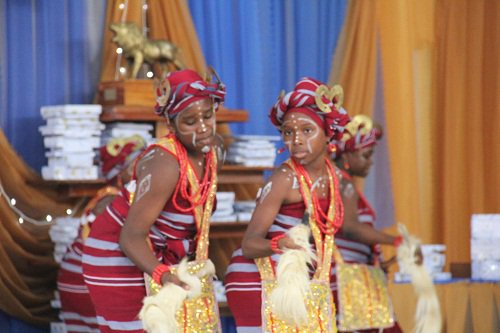
In the heart of Ondo town, the Ekimoguns, as the Ondo people are called, celebrate the transition of their girls into womanhood through a festival-like rite known as ‘Obitun’which means ‘new woman’. The Obitun festival performed in the olden days of the Ondo people is a way different from the modern Obitun cultural dance now performed as a mere entertainment during public functions. It is only the dancing aspect of the old Obitun that was retained by modern sons and daughters of Ondo, the initial rite and intention of Obitun has gone into extinction. In the olden days of Ondo people, Obitun was believed to be a sacred rite, and a very important milestone in the lives of young but matured girls. They believed that for a girl to become a woman, she must go through Obitun, otherwise, bad lucks and problems such as barrenness and broken marriage would befall her.
But today, owing to Western education, christainity and some other religious beliefs, most families in Ondo do not consider Obitun important for their daughters before being acknowledged as a woman and getting married. But nevertheless, the Obitun tradition still thrive among some set of the Ondo people even though it is being threatened by extinction.
Back in the early days, Obitun festival was usually held for a week. The girls initiated during the festival were treated with extra care and love. They were beautifully dressed and decorated with exquisite beads and camwood face paintings. Part of Obitun costume are horsetails, fans and beaded wallets which is worn across the shoulders.
Throughout the Obitun festival, the initiated girls were not called by their names, instead, they were called ‘Obitun’ which means new woman. There were usually plenty of foods at Obitun festival; the most common of all is pounded yam and okra soup. These foods were offered as sacrifice to the spirits of the newly initiated girls (Obitun) to guide them in their journey to womanhood. On the last day of the festival, the newly initiated girls would all together dance round the town stopping at some important places such as the houses of their relatives where they would be praised and lavished with gifts. They would also stop at some shrines such as Ogun lei, and Ogun Aisero in Ododibo and Odojomu to give final thanks to their creator.
In recent times, all these aspects of Obitun has been scrapped out leaving only the dance session. The Obitun cultural dance of Ondo people is now performed by cultural dance troops just to entertain people at ceremonies.



 Pic. credit- Abia State Tourism and Culture
 Mary Slessor