THE ORIGIN OF YORÙBÁ’S “GUDU GUDU MEJE AT YA YA MEFA”
Some Ibadan Chiefs went to a meeting with an Oyinbo District Officer.
In the course of the meeting, the Oyinbo man was so happy with what the Ibadan Chiefs had to report via an interpreter and he kept saying
good good good good good good good
yeah yeah yeah yeah yeah yeah
One of the Chiefs counted the number of the “good” [which was 7] and “yeah” [which was 6].
When they got back to Ibadan, he reported to Ibadan folks that the Oyinbo man was so impressed that he responded with “good good” (gudu gudu) 7 times and “yeah yeah” (ya ya) 6 times
The Ibadan chief said “Òyìnbó náà se gudu gudu méje àti yà yà méfà”
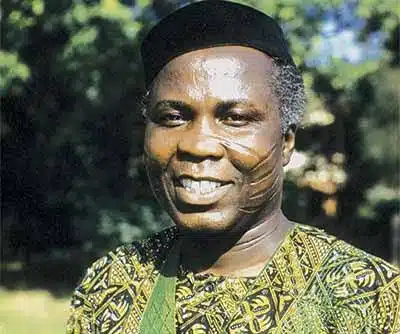
The biography of His Royal Majesty Alayeluwa Oba Jimoh Oladunni Oyewumi Ajagungbade III JP, CON, the immediate past Soun of Ogbomosoland is an interesting one.
To be born into royal lineage does not confer automatic kingship status on all princes, princes are born but kings are made through divine intervention. His Royal Majesty Oba Jimoh Oladunni Oyewumi Ajagungbade III JP, CON, Soun of Ogbomosholand was born on May 27, 1926- a month after the birth of another monarch, Queen Elizabeth II of England.
His father was His Royal Highness Oba Bello Afolabi Oyewumi Ajagungbade II (the Baale of Ogbomoso from 1916 to 1940), and Ayaba Selia Olatundun Adunni Oyewumi of Arowomole compound of Arowomole, Ogbomoso. He was the youngest of his mother’s three male children. His father had many wives and 63 children.
Because of his mother’s proclivity to give birth to male children in a household where other queens had a preponderance of female children, she found herself in the midst of envy and discrimination from the other wives.
It was rumoured that Oba Oyewumi’s mother when she was pregnant with the now monarch consulted an Ifa priest to make an attempt to change his sex to a female in the womb but this failed, the other Ayabas having threatened her against giving birth to another male child. Therefore, the mother and child were much travailed after the prince was born.
Prince Oladunni Oyewumi was the youngest of his mother’s three male children, a development which attracted open rivalry, serious recriminations, and unpretentious jealousy among the other olori (wives) whose children are mainly female.
After the birth of Prince Oladunni, many troubles began to brew in the palace while Olori Olatundun was abandoned with her fate.
To escape the unabated animosity directed against them, his mother, taking him along left the palace first for her family house at Arowomole and then for Ibadan and then relocated to Ibadan with an uncle domiciled in that city.
After about six years in Ibadan, Prince Oladunni started his elementary education at St Patrick’s School, Oke Padre, Ibadan.
Early Struggles
Prince Jimoh Oladunni started his educational career at St. Patrick’s School, Oke-Padre, Ibadan. But the death of his father in 1940 meant that a return to Ogbomoso with his mother for the wife to mourn her husband was imperative.
The school was the precursor of Ogbomoso Grammar School. With his mother, he had relocated to the Arowomole compound since the household of the deceased Oba had to leave the palace. Eventually, his dream of schooling was aborted due to financial constraints.
There was no help so, he reluctantly became a farm help, under one of his brothers, Dawodu Laleye, who initially promised to assist with his education.
His brother was supposed to fund his education but he kept on stalling and so one day, he fled to an Ijesa community to try his hand at gold mining.
But there, all he could lay his hand on was cloth weaving. But the spirit of hard work and determination that would later mark his adult life manifested from this time and so he was able to save some money from this business.
He decided to return to Ogbomoso in 1943 but on the trip back he lost all his savings to money doublers and gamblers at Ede. Thus, he arrived in Ogbomoso penniless. He was not down nonetheless.
He went back to the cloth-weaving business and had a stall at Arowomole market. He used to ride a rickety bicycle to Ilorin to buy cotton for his business but he never minded, he was focused on success.
Then, in 1944, a window of opportunity opened for him as a maternal uncle living in Jos, who came to Ogbomoso to get married, took him along while returning to his abode in Jos.
He arrived in the tin city of Jos on May 17, 1944, where he soon began to assist his elder brother (of the same mother), Prince Moses Oyelowo Oyewumi, a tailor, who already was living in Jos, to sell clothes.
He later convinced his brother to let him practice cloth-weaving, the products of which they sold. The business prospered though at great exertion because he used to trek long distances to sell the woven clothes at mining sites all around Jos.
He served his brother with devotion and was exceedingly honest. Even when Oyelowo went back to Ogbomoso to get married in 1945 and was stranded back home for six months due to a workers’ strike, Oyelowo returned to see the products well kept and his business intact. A rare thing today!
In 1946 nevertheless, the spirit of self-actualization overwhelmed the young Oladunni and he decided to be independent. He received the blessing of his brother, who gave him an old sewing machine and a sum of two pounds, sixteen shillings to start off.
He bought and sewed clothes which he sold. Because he poured his heart into the work and turned out exquisite designs, his business witnessed a tremendous spike and he began to flourish.
Oladunni, the businessman now really began to unravel.
Career And Accomplishments
The then Prince Oyewumi now set his eyes on real success. At just 20, he began the journey to the top. He took his savings of about 50 pounds to start trading in bicycles, specifically, double spring Raleigh, which he sourced from Lagos, and he began to make money.
However, life is always full of twists and turns. He soon fell victim to fraudsters; he trusted someone who assured him he would help buy the products directly from the UAC at very cheap rates.
So, they went together to the company; he handed the money to the man who pretended to go into an office but bolted away through an exit door unknown to the young prince. He had lost four pounds, fifty shillings.
It was a crushing blow but he soon gathered himself and the dream of being educated, he enrolled for evening classes at St. Paul’s School in Jos.
While doing this, he did not lose sight of his goal, and one day, he walked into the GB Olivant to look over the shop, While there, he came across a manager in the company, a certain Mr. Smith, who was a Scot national. They bonded and became friends.
Over time, Mr Smith offered Prince Oyewumi an attractive business deal, which involved being given goods on credit and making payment after sales, an opportunity he grabbed with both hands.
This opened a new vista of prospects for him which he masterfully explored. He continued to have a robust relationship with Mr. Smith and this association helped him a lot to hone his business skills.
He continued to grow and would later do business with other conglomerates like PZ, SCOA, and CFAO.
Then Merchant Prince Jimoh Oyewumi (Later Soun Of Ogbomoso), Chief Lagbemiro (In suit) ‘Of the ADABA ONA NI ANKUN’ GBE FAME, and their business Partners in Jos, Plateau State
His association with Smith was a real blessing to him, he was to Prince Oladunni what some people call “destiny helper” today.
Smith introduced him to other expatriates who also found his honesty and entrepreneurial acumen worthy.
He met Mr. Holford, the manager of the then Barclay’s Bank, through Smith; he opened an account with the bank which began to advance him credit facilities with which he expanded his business.
By 1950, Prince Oyewumi had become sufficiently established in his trading business that he decided to get married. He got married to his most senior wife Olori Igbayilola Oyewumi.
In 1954, he was made the sole distributor for CFAO in Jos. He now became a big-time businessman and travelled to France in 1958 and to some other European countries including Germany, where he was appointed as the distributor of Becks beer in Nigeria.
He made some other business deals across Europe which entrenched his international status as a businessman.
He also consolidated in Nigeria and became a charming prince dashing across Nigerian cities to forge new business deals. But fate had a greater role for him.
His fame soared across Nigeria, becoming widely known as the “The Prince.” His business interests cut across many sectors. in the 1950s, He built the very popular Terminus Hotel, in Jos, and later in Osogbo before that of Ogbomoso.
The area where his Terminus Hotel, Jos Plateau state stands is now one of the most popular and busiest areas in Jos to date.
By 1958, the wealthy prince had started showing interest in estate development and property acquisition, and in that same year, the Prince met a European who so much admired his entrepreneurial ability that he offered to take him on a business vacation trip to the continent of Europe upon which they travel to France, Paris and United kingdom.
ASCENSION TO THE THRONE
In 1973 the Oyo state military governor invited the Gbagun ruling house to present a candidate for the appointment as Soun of Ogbomosoland after the passing away of the former king.
Ninety-four members who were of the Gbagun ruling house met and two candidates emerged to contest for the vacant stool but it turned out that 90 out of the 94 decision-makers favoured the candidacy of Prince Jimoh Oladunni Oyewumi.
With such majority support the then Prince Oladunni became the Soun to the delight and acceptance of his people.
He was traditionally installed on December 14, 1973, as the 20th Soun of Ogbomoso and coronated on January 12, 1974.
Meanwhile, The Late Oba Jimoh Oladunni Oyewumi’s installation as Soun instigated a major crisis in 1973.
This is because he dared to do what his predecessors did not do – wearing a beaded crown because the stool was considered that of Baale.
Yoruba Obas were alarmed, from Ife to Oyo, to Abeokuta, to Orangun-Ila and so on, there were hurried meetings to plan how to forestall “this upstart from committing a sacrilege.”
They cried foul that as Soun he was not entitled to wear a beaded crown, They conspired with the governor of the then Western State, Brigadier Oluwole Rotimi to thwart the move but he was adamant in the true spirit of his Ajagungbade cognomen.
His grandfather Gbagunboye Ajamasa Ondugbe (1870 – 1877) became known as Ajagungbade I after his heroics in battles.
It was at a battle in Ilesa in 1870s, where he led Ogbomoso warriors, that he reportedly beheaded a sovereign and took his crown as his own!
Then, Soun had his reasons, if he was constantly greeted, “K’ade pe lori, ki bata pelese,” but he had no crown to show for it, it amounted to a mockery of his position.
He further claimed that his grandfather – Gbagun – fought gallantly to win that crown earning him the appellation, Ajagungbade literally meaning the one who fought in battle and claimed the crown.
His grandfather despite being regarded and acknowledged as Ajagungbade I in the 1870s and the size and fame of Ogbomoso as home of the brave From the time of the first Soun, Ogunlola Ogundiran to Jogioro, to Kumoyede to Toyeje Akanni, Ogbomoso’s stool was still not upgraded to the status of Oba.
Late Oba Jimoh Oyewumi’s own father Baale Afolabi Bello Alabi Oyewumi (1916 – 1940) despite being the Ajagungbade II was not also upgraded to the status of an Oba.
This simply can’t continue now.
“Ajagungbade III is an Oba, the Soun, not a Baale”. The late Soun insisted and so it remained till date.
His traducers asked him to name the Oba from which Gbagun claimed the crown but he strongly countered: “Name the Oba that lost his crown and I will tell from whom he gained the crown!”
They had no answer to this. The ding-dong persisted. The Military Governor also warned him sternly against the act but he was undaunted.
He is bold, and courageous and his nerves are made of steel.
That saved the day for him. He dared the whole establishment and came out victorious.
He wore the beaded crown both at the installation and coronation ceremonies on December 14, 1973, and January 12, 1974, respectively.
The local council had also threatened not to fund the installation ceremony if he insisted on wearing the much-vaunted beaded crown, but he called its bluff and funded the ceremony from his purse.
Oba Oladunni Oyewumi is an example of the indomitable spirit of the ancient Ogbomoso warlord, which made a difference during the Fulani onslaught against Yorubaland in the 1800s.
That was the first of his numerous accomplishments for Ogbomoso.
An untoward consequence of this plot against him according to him is the loss of the prescribing authority of the Obas to determine who wears a beaded crown to the government.
LEGACY AND ACCOMPLISHMENTS
The contributions of Oba Oladunni Oyewumi to the growth and development of Ogbomoso cannot be exhausted in volumes of books not to talk of a website like johnsonokunadea.com.
He had breathed into the city his adventurous spirit and cosmopolitan outlook to make an unbelievable impact. He is the monarch who built a semi-town into a metropolis of no mean value.
He is the overlord who overnight changed the status of his stool, from Baale to Oba. Many of us, who walk the streets of Ogbomoso today, filled with pleasure about its magnificence, would have been confronted with a bucolic community.
This traditional ruler has something in him, his wide connections coupled with his charming personality often stand him in good stead in attracting development.
He is the monarch who restored Ogbomoso’s boundaries and thrust it to its greatest apogee. When he assumed the stool, Ogbomoso had only three taxi cabs, only three secondary schools, lopsided electricity, limited telephone facilities, poor infrastructures especially in respect to roads, and so on.
We are all witnesses to how the narrative has changed today. One may think that any Oba who sits on the throne would have done the same, but this is a wrong assumption.
He is a man of great assets, in terms of wealth and personality, these are at his beck and call to facilitate developments, particularly at the inception of his reign.
It was his persona that made Ogbomoso a kingdom today ruled over by a king, Had it been someone else, who lacked grains of courage, knowledge, and wherewithal, the migration to the status of Oba wouldn’t have occurred in time.
In 1976, in fact, his struggles ensured that the Soun became an Oba officially. It is on record that the agitation of Oba Oyewumi facilitated this upgrading, which rubbed off well on the Ibadan traditional stool too for the stool was that of a Baale
He brought immense prestige to the throne of Soun and it was him that made it rank with the highest-ranked across the country today.
Also to his eternal glory, he caused the rebuilding of Ogbomoso palace to a befitting one after he ascended to the throne.
The old building consisting of a rustic upstairs built of mud was pulled down for the masterpiece that is Ogbomoso Palace today.
It was officially opened in March 1978. Furthermore, he spearheaded the legal battle over the boundary of Ogbomoso and Oyo. While Alaafin claimed the boundary was at Odo-Oba, Soun insisted it was at Ipeba.
It should be noted that this struggle spanned many decades, about 75 years. Oba Oladunni Oyewumi reopened it and it ended in victory for Ogbomoso in 1984 when the city claimed victory at the Supreme Court.
In that fashion, Ogbomoso won back many of its communities and lands.
The siting of a university and two teaching hospitals, a good network of roads, a television and two radio stations, a Federal Government College, a Government Technical College, numerous secondary schools (both public and private), several commercial and microfinance banks including a branch of the Bank of Agriculture, dual carriage roads, stadium, police area command and many more are some of the legacies that will forever define his reign.
The beautiful thing about all this is that upon mounting the saddle, he approached the right authorities to bring these things.
For instance, he just invited old acquaintances who headed NITEL and the electricity company at Osogbo at the time to significantly improve their services in his domain and these were affected.
So is the case with the upgrading of the Ogbomoso command to an area command.
Also, many indigenes of the city continue to rise in status in their careers occupying eminent positions that buoy the prestige of the community in the comity of communities.
late Soun Ajagungbade III bagged many awards and recognitions including being conferred with the prestigious national awards of Commander of the Order of Niger (CON) and Commander of the Federal Republic (CFR), the second being the highest conferred on any traditional ruler.
He was the Chancellor of Plateau State University till his death and he is a highly revered traditional ruler.
He has his flaws no doubt but the greatness he impacted on Ogbomoso is evidence of his own greatness. On a personal level, he is a job creator in Ogbomoso, his interests cover oil and gas, real estate, hospitality, etc.
Old age eventually set in, and his vitality and agility were reduced, slowing him down significantly but the sharpness and clearness of his mind till his final breath were still with him and in his head was continuously conjured the bright things he desired for his kingdom.
The Soun of Ogbomoso, His Royal Majesty Oba Jimoh Oladunni Oyewumi Ajagungbade III JP, CON, joined his ancestors in the wee hours of Sunday, 12th December 2021 at the very ripe age of 95 and impactful 48 long years of serving Ogbomoso people diligently; the longest-reigning monarch of the 27 rulers Ogbomoso ever had.
A List of Oba (Kings) Traditional Titles in Yorubaland
In Yoruba land, the Oba is an unquestionable monarch. He is not primus inter parels (first among equals), he is revered and widely known as being second only to the gods- “Igbakeji Orisa”.
Below is a list of Obas (kings) Traditional titles in Yorubaland
Ooni of Ile-Ife
Alaafin of Oyo
Awujale of Ijebuland
Alake of Egbaland
Olowu of Owu
Olubadan of Ibadan
Soun of Ogbomoso
Oba of Benin
Owa Obokun of Ijesha
Osemawe of Ondo
Ebumawe of Ago Iwoye
Ataoja of Osogbo
Deji of Akure
Timi of Ede
Orangun of Ila
Alapa of Okin-Apa
Olofin of Ado-Odo (Oba of Ado)
Eleko of Eko
Aresa of Iresa (Aresapa of Iresa apa, Aresadu of Iresa Adu)
Olugbon of Orile Igbon
Onikoyi of Ikoyi
Alaje of Ilu-Aje
Okere of Saki
Aseyin of Iseyin
Onilala of Lanlate
Eleruwa of Eruwa
Alaketu of Ketu
Alepata of Igboho
Oluwo of Iwo
•••
Olugbo of Ugbo
Olowo of Owo
Ajero of Ijero-Ekiti
Alara of Aramoko-Ekiti
Alawe of Ilawe-Ekiti
Ewi of Ado-Ekiti
Ologotun of Ogotun-Ekiti
Oloye of Oye-Ekiti
Owa Ooye of Okemesi-Ekiti
Olu of Itori
Alaga of Aga-Olowo
Olusi of Usi
Olofa of Ofa
ọwá of idanre
•••
Akarigbo of Remo
Olu of Mushin
Alaperu of Iperu
Onisaga of Isaga
Olubara of Ibara
Ogiyan of Ejigbo
Lalupo of Gbagura
Alaye of Aiyetoro
Olota of Ota
Olu of Ilaro
Olufi of Gbongan
Attah of Ayiede Ekiti
Ebumawe of Ago-Iwoye
Onjo of Okeho
Ayangburen of Ikorodu
Ogoga of Ikere
Orimolusi of Ijebu-Igbo
Akaran of Badagry
Akire of Ikire
Osolo of Isolo
•••
Oniwere of Iwere-Ile
Apetu of Ipetumodu
Olu of Mushin
Alaye of Efon-Alaye
Onisanbo of Ogboro
Aare of Ago-Are
Olojee of Oje-Owode
Asawo of Ayete
Onigbeti of Igbeti
Olokaka of Okaka
Onipopo of Popo
Onitede of Tede
Onisemi of Isemi
Onipapo of Ipapo
Alageere of Ofiki
Ajoriwin of Irawo
Onimia of Imia
Onidere of Idere
Obaro of Kabba
Olore of Ore
Onpetu of Ijeruland
Osile of Oke-Ona egba
Orimolusi of Ijebugbo
Onido of Iddo
Onigbaja of Igbaja
Onibeju of Ibeju-Lekki
•••
Oloja of Epe
Alaawe of Awe
Oba of Agboyi land
Olugijo of Ogijoland
Alabere of Abere Ede
Ologobi of Ogobi Ede
Olu of Sekona Ede
Olu of Owode Ede
Owa Ale of Ikare
Omola of Imala
Alara of Ilara-Mokin
Akibio of Ilora
Olofun of irele
Jegun of Idepe
Jegun of ile-Oluji
Orungberuwa of Ode-Erinje
Halu of Ode Aye
Laragunsin of Iyasan
Lapoki of Igbolako
•••
Alara of Igbokoda
Lumure of Ayeka
Sabiganna of Igana
Afonja of Ilorin
Owa of igbajo
Onijaye of Ijaye
Oloro Of Oro
elesa Of Oke Ode
Ogunsua of Modakeke
Oluressi of lressi
Olojudo of Ido-Ekiti
Owa-Oye of Oke-Imesi
Olokuku of Okuku
Olunisa of Inisa
Oloyan of Oyan
Onijabe of Ijabe
Onigbaye of Igbaye
Afaji of Faji
Akosin of Ekosin
•••
Alaje of Ilu Aje
Olokua of Oku
Alagbeye of Agbeye
Onila-odo of Ila-odo
Atapara of Iyeku
Elekusa of Ekusa
Olojudo of Ido Faboro Ekiti
Alase of Ilasa Ekiti
Sano of kogga
Alasaba of Asaba
Alasi of Asi
Olopete of Opete
Olopanda of Oponda
Aromolaran of ijesaland
Olu ifon of ifon
Odemo of Isara
Aringbajo of Igbajo Ijesa
•••
Alamodu of Ago-Amodu
Onigbope of Igbope
Obalufon of Sepeteri
Alagbole of Agbonle
Olowu of Telemu
Odemo of Ishara remo
Olaogboru Adimula of Ifeodan
Aragbiji of Iragbiji
Olororuwo of Ororuwo
Olona of Ada
Alaagba of Aagba
Are of Ire
•••
Alageere of Ago Are,
Oloto of Are
Oloba of Oba Osin
Oloru of Oru Ijebu
Olu of Ile-Ogbo
Olokuku of Okuku
Oluressi of lressi
Ajalorun of ijebu ife
Oloko of ijebu imushin
Elese of ilese ijebu
Moyegeso of ijebu itele
Owa-akinfin of ikinfin
Oloko of oko
Oloba of oba-oke
Oniluju of Iluju
Onifaji Of faji
akosin Of ekosin
•••
onigbaye Of igbaye
olokuku Of okuku
olunisa Of inisa
Owa Oroo of Agbado Ekiti
Aree of ireeland
Owa of Otan Ayegbaju
Aragberi of Iragberi
Alayegun of Ode-Omu
Owatapa of Itapa Ekiti
Oloro of Oro
Eleju of Sanmora
Onikoko of Koko
Oniganmo of Ganmo
Olupo of Ajassepo
Elesie of Esie
Elese of Igbaja
Aala of Ilala
Oloyopo of Eggi-Oyoipo
Oludopo of Okeyapo
Aboro of ibese land
•••
Olu of sawonjo
Eleyinpo of Ipapo
Onisemi of Isemi-Ile
Oluigbo of Igbojaye
Awaraja of Iwaraja
Alana of Oke-ana
Alatori of Atorin Ilesha
Alada of Ada
alaigbajo of arigbajo
onifo of ifo
Olorile of orile Ifoland
Oni ilepa of ilepa ilepa
Edemorun of kajola
•••
Olomu of omu aran
Aloffa of ilofa
Olosi of Osi
Elepe of epe
Ekesin of ora igbomina
Olobaagun of Obaagun
Olugunwa of Oke Amu
Ololo of Oolo
Onimaya of maya
Onidada of dada
onidiemin of idi-emin
Onipara of Ipara
Olokua of Okua
Alaaye of Oke-Ayedun
Oniroko of Iroko land
Owatapa of Itapa Kingdom
•••
Olowu of Owu-Kuta
Elese of Igbaja
Oree of moba land
Oree of otun
Ẹbùrù of ibà.
Agbolu of Agbaje
Olu of Afowowa Sogaade
Oloto of Ofiki
Aare of Sando Ofiki
Oloba of oba
Alakola of Akola
Olora of Ora-Ekiti
Olopete of Opete
Alakanran of Araromi
Alararomi of Araromi Aperin
Oniye of Iye-Ekiti
Olowu of owu-isin
olusin of isanlu-isin
olusin of ijara-isin
olusin of iji-irin
oniwo of oke-aba
oniwo of odu-ore
oloba of oba-isin
elekuu of odo eku-isin
•••
alala of ala-isin
eledidi of edidi
onigbin of oke-onigbin
onigbesi of igbesi
Onikole of ikole kingdom
Elegboro of Ijebu-Ijesha
Abodi of ikale land
Olokaka of okaka
Akinyinwa of ikinyinwa
Oluaso of iberekodo land
Oniwere of iwere ile
Salu of Edunabon
Olubaka of Oka land
•••
Onikereku of ikereku
Olukoro of Ikoro Ekiti
Onidofin of idofin
Obawara of iwara-ife
Awara of iwara-ijesa
awara of iwara- Iwo
ogogo of ifewara
Olu of Okeamu
Onigbope of Igbope
Asigangan of Igangan
Olusin of Isanlu Isin
Alaremo of Aremo
Olubosin of ifetedo
Asaooni of Ora Igbomina
•••
Olosan of Osan Ekiti
Elerin of Erinmope
Ajalorun of ife ijebu
Aale of Okelerin
Alabudo of abudo
Onigbamila of gbamila
Alaaye of aye
Olokusa of okusa
Onilai of ilai
Gbelepa of gbelepa
Alaboto of aboto
Onidigba of idigba
Agura of gbagura
Oshinle of okeona
Oloyan of Oyan
Olubaka of Oka land
Aboro of Ibooro land
Olojoku of Ojoku
Onika of Ika
Olomun of omuaran
Onilogbo of Ilogbo
Olumoro of Moro land
Onimeko of Imeko land
•••
Oloola of Ilara
Onidofa of Idofa
Ooye of Iwoye
Obaladi of Afon
Olu of Imasayi
Oluresi of lresi
Obaro of Kabba
alado of ado awaye
alawaye of awaye
Onisan of isan Ekiti
Elero of ilero
Olomu of omupo
Alaran of aran orin
Oluware of iware land
Aganmo of ganmo
Oloola of Ilara-Yewa
Onidofa of Idofa
Ooye of Iwoye
Onipara of Ipara – Remo
Odemo of Isara – Remo
Alakaka of Akaka – Remo
Alara of Ilara – Remo
•••
Agbowu of Ogbaagbaa
Owa of Igbajo
Elerin of Erin Ile
Onibereko of Ibereko
Oore of moba land
Oloba of obaile
Onirun of irun Akoko
Ologbagi of Ogbagi Akoko
Oni lrun of lrun Akoko
Elese of Ese Akoko
Deji of Arigidi Akoko
Ologbagi of Ogbagi Akoko
Oni Irun of Irun Akoko
Elese of Ese Akoko
Eleyinpo of Ipapo
Onidofian of idofian
Alamonyo of amonyo
Onijoun of ijoun
Alagutan of Abegunrin land
Onífẹ̀dẹ̀gbó of Fẹ̀dẹ̀gbóland
Aláyégún of Ayégún
Alie of Ilie
Onitabo of Itabo
Alado of Ado-Awaye
Asu of Fiditi
Olupako of Shaare
Alapomu of Apomu
Alakire of Ikire
Oliyere of Iyere
Oniro of Komu
Akirun of Ikirun
Onidere of Idere
Alajinapa of Ajinapa
Onitewure of Tewure
Arinjale of Ise Ekiti
Olute of Ute
•••••••
Let’s continue learning. Please drop the traditional title of a Yoruba king in the comment box below, we’ll keep updating till we have a concise compilation of Traditional titles.
Welcome! You are on your path to discovering how to prepare a mouth-licking, palatable recipe… You can and will prepare a sensational Yam Pancakes conveniently.
INGREDIENTS
Yam
Flour
Grounded pepper
Egg
Oil for greasing
DIRECTIONS
Peel and grate the yam.
Soak for about 20 minutes
In a bowl, add the flour, pepper.
Break in the eggs and add a little water, mix together to form a thick consistency.
Then add the grated yam.
Grease a frying pan with oil, pour in the batter, leave on a side for 3 minutes, flip over and leave for another 3 minutes till both sides are cooked.
Reheat and re grease the pan, repeat the process.
Your Yam Pancakes is ready. Serve with any sauce of your choice (just like yam and stew, but with a twist!).
Written by Gbemisola Akinloye
Gbemisola is a chef, nutritionist and food photographer.
None of Alaafin Abiodun‘s numerous children succeeded him on the throne. Aole, a tall and handsome. Prince, a cousin of the late King was elected in his stead. But unfortunately, Alaafin Aole Arogangan’s reign was a very unhappy one; it marked the commencement of the decline of the nation until it terminated in the tragic end of the fifth King after him.
Laiye Abiodun l’a fi igba won’wo
Laiye Aole l’adi adi kale.
In Abiodun’s reign money we weighed by bushels
In Aole’s reign, we packed up to flee.
But there was nothing more in his actions than in those of his predecessors to warrant this saying, on the contrary, he was probably too weak and mild for the times.
On the Alaafin Aole Arogangan’s accession, according to custom when the time came for him to send out his first expedition, he was asked who was his enemy, that they should fight him. Alaafin Aole Arogangan named the Bale of Apomu , and hence Apomu was doomed.
Apomu was the market town where Oyos, Ifes, Owus, and Ijebus met for trade. It was situated in Ife territory, and in the border of the Olowu’s dominion. Raiding and man-stealing were rife at those times. Oyos particularly were in greater danger, as they came from afar.
During the last reign several Oyos were stolen and sold here, and hence King Abiodun sent orders to both the Olowu and the Ooni of Ife to keep a strict watch and prevent the recurrence of these practices. The Ooni and the Olowu in turn sent strict orders to the Bale of Apomu to be on the watch, and arrest any offender.
Alaafin Aole Arogangan who was then a private man used to trade in these parts with a friend who was also his attendant; and on one occasion, he bartered away his friend for merchandise!
The Ijebus were actually taking him away when it was reported to the Bale of Apomu that an Oyo man was being sold away. Fortunately for the man by the prompt action of the Bale he was rescued at a certain spot named Apata Odaju (the rock of the heartless), perhaps so named from this circumstance, and brought before the Baale.
Investigation soon showed who the slave-dealer was; but as Aole was an Akeyo (Prince) and could not more severely be dealt with, in order that justice may not miscarry, he was ordered by the Bale to be severely flogged. This was the reason why Alaafin Aole Arogangan now named the Bale of Apomu as his enemy.
When the Baale of Apomu heard that war was declared against his town on his account he took refuge in the court of the Ooni of Ife his over-lord, and whose orders he had obeyed.
But as the offense was against the Suzerain, even the Ooni could not save him; so this faithful Baale, in order to save his town and his people from destruction, committed suicide, and his head was cut off and sent to Oyo to appease the offended monarch!
But an expedition must in any case be sent out, Alaafin Aole Arogangan was, therefore, approached again and asked to name his enemy for the second time since Apomu was not raided due to the bravery of the Baale of Apomu.
But Alaafin Aole Arogangan replied, “My enemy is too formidable for me” Being pressed, he named the powerful chief Afonja (who eventually became the Kakanfo and his nightmare) residing at Ilorin with great reluctance, as he foresaw evil ahead.
After the death of the Kakanfo Oyabi, Afonja of Ilorin demanded the title; but as a Prince (through the mother) the title was below his rank, for the Kakanfo ranks after the Basorun, but being the highest military title, it suited his restless nature best, and so he obtained it, almost by force.
But Alaafin Aole Arogangan was unwilling to initiate any civil war, and refused to take any action against Afonja after he had granted him the title.
Hitherto, Afonja alone was his enemy, the other chiefs were as yet loyal to him, but circumstances occurred, one after the other which created a disaffection between him and the Basorun and the other chiefs, fanning into a flame the destructive fire already smouldering in its embers.
The cause of quarrel between Alaafin Aole Arogangan and Asamu the Basorun was this :—
One Alaja-eta a Hausa trader at Oyo was plundered of his goods, under the pretext that he was bringing bad charms into the city. Among his confiscated goods was his Koran which he prized more than all his other stolen property.
He appealed to Alaafin Aole Arogangan, and he, from a sense of justice ordered that all his goods be restored to him. All but the Koran were accordingly restored.
The Hausa again appealed to Alaafin Aole Arogangan for this his most valued treasure; Alaafin Aole Arogangan insisted that search should be made and the lost Koran be restored. The Basorun in whose possession it probably was, or who at any rate knew where it could be found, refused to restore it and told the King it could not be found!
His Majesty felt this keenly as an insult to his dignity; Alaafin Aole Arogangan was heard to say “Is it come to this that my commands cannot be obeyed in my own capital? Must it be said that I failed to redress the grievance of a stranger in my town? That he appealed to me in vain?”
Turning to the Basorun and pointing upwards he said, ” Very well then, if you cannot find it my father (meaning the deified Sango) will find the Koran for me.”
As the god Sango is reputed to take vengeance on thieves and liars by burning their houses, so the next day, when lightning struck the Basorun’s house, great was his rage against the King for being instrumental in convicting him of theft and lying!
The ceremony of appeasing the god by the devotees, entailed heavy expenses on the Basorun who, had it been another man’s house might have gone shares with the Alafin in the fines imposed upon the sufferers.
He knew where the trouble came from, for he noted Alaafin Aole Arogangan‘s words “My father will find it for me.” In this way be became the King’s enemy.
Another circumstance occurred which added the Owota one of the Esos to the list of Alaafin Aole Arogangan‘s enemies. One Jankalawa who had offended the late King and who had escaped to the Bariba country when he sought to kill him, now returned after the King’s death and was flaunting about the streets of Oyo under the protection of Lafianu the Owota.
The late King‘s wives were angry at this and complained to Aole against Jankalawa. Said they “You have inherited our late husband’s wives, his treasures, slaves and his throne. Why not make his cause your cause and his enemies yours as well? Why do you allow this Jankalawa to stalk so defiantly about the streets of Oyo?”
By thus appealing to him from day to day, Alaafin Aole Arogangan yielded to their entreaties and remonstrances, and ordered the arrest and subsequent execution of Jankalawa. The Owota’s pride was wounded, because he was not respected by Alaafin Aole Arogangan, in that one known to be under his protection should be so summarily dealt with.
Thus the Basorun and the Kakanfo found an accomplice in the powerful Owota. A conspiracy was formed but not being ripe for execution, they awaited a favorable opportunity.
At length the time arrived when an expedition must be sent out, and Alaafin Aole Arogangan was again asked “Who is your Majesty”s enemy?” He replied, “I have told you earlier that my enemy is too formidable for me, and besides we are the same kith and kin.”
However, he advised that as the last campaign ended at Gbeji, the war should be prosecuted from that place. But in order to gain their object in view, which is the removal of the Kakanfo, the King’s Councillors advised that the Kakanfo and the army should be sent against Iwere.
Iwere is a place fortified by nature and by art, and impregnable to the simple weapons of those days, and as the Kakanfo by the oaths of his office must either conquer within three months or die, and Iwere is impregnable, he will have no other alternative, but as in honor bound to make away with himself.
It was, however, arranged that he should not be forewarned, but decoyed as it were to that place until he found himself at the foot of the hill on which Iwere was built; hence it was given out that war was declared against Gbeji. But the royal party leading the army received private instructions to lead the army to Iwere and when there to inform the Kakanfo that that was the place he was sent against.
But private intelligence had reached the Kakanfo at Ilorin, of all the plots and intrigues going on in the capital. However, he with his accomplices in the city deferred the execution of their design till after their arrival at the seat of war.
The army at length stood before Iwere and the Royal party, consisting of Alaafin Aole Arogangan‘s brother, the Eunuchs, and the principal slaves, and their men, pointing to it said “This is the town to be taken by the order of the Alaafin.”
The time was now come for the mutiny to break out. The Basorun and the Owota at the head of the troops from the city, the Onikoyi and the Kakanfo leading those from the provinces now alleged as a pretext for the mutiny that “If the King had not aimed at our destruction, he would not have ordered us to this impregnable town. And besides, is not this the maternal town of Alaafin Ajagbo? Are there not Kobis in the Queen Mother’s palace there?”
The watchword was now given “O Ya” (now is the time) and so the whole army turned their swords upon the royal party and massacred them!
Chief Opele of Gbogun in particular was famous as a swordsman; he made himself notorious on that occasion, and took to himself a name “A ri agada pa aburo Oba ” (one who has a blade for slaying the King’s brother).
The siege was immediately raised, and the whole army stood before the city for forty and two days. Alaafin Aole Arogangan sent word to say if they have returned from the expedition, whether successful or unsuccessful, let them come in for an interview.
The insurgent chiefs sent word back to say that the royal party had offended them and that the result had proved unfortunate. “Very well,” said Alaafin Aole Arogangan, “in any case, come in for an interview.”
Several weeks passed, and they were still encamped before Oyo irresolute as to what they should do next. At last an empty covered calabash was sent to Alaafin Aole Arogangan—for his head! A plain indication that he was rejected.
Alaafin Aole Arogangan had suspected this all along and was not unprepared for it. There being no alternative His Majesty set his house in order; but before Alaafin Aole Arogangan committed suicide, he stepped out into the palace quadrangle with face stern and resolute, carrying in his hands an earthenware dish and three arrows.
Alaafin Aole Arogangan shot one to the North, one to the South, and one to the West uttering those ever-memorable imprecations, “My curse be on ye for your disloyalty and disobedience, so let your children disobey you. If you send them on an errand, let them never return to bring you word again. To all the points I shot my arrows will ye be carried as slaves. My curse will carry you to the sea and beyond the seas, slaves will rule over you, and you their masters will become slaves.“
With this he raised and dashed the earthenware dish on the ground smashing it into pieces, saying ” Igba la a pa a ki pa awo, beeni ki ori mi o, mo se to! to! ” (a broken calabash can be mended, but not a broken dish; so let my words be—irrevocable!) He then took poison and died, after which the camp was broken up, and each of the chiefs repaired to his own place.
Thus ended an unhappy reign of about seven years, and Prince Adebo succeeded him on the throne.
Asamu Agba-o lekan was the Basorun of Alaafin Aole Arogangan’s reign.
LADI KWALI: THE ONLY SIGNIFICANT WOMAN ON THE NIGERIAN CURRENCY
All Nigerian currencies have the faces of prominent people on them. For the 20 Naira note, however, the mint green note which shares a colour family with the American dollar has two notable Nigerian citizens on it.
The front of the note has Former Head of State, General Murtala Muhammed, while the back bears renowned Nigerian potter, Ladi Kwali.
LADI KWALI, the woman at the back of the ₦20 remains the only significant woman on the Nigerian currency. She was an exceptional world-class Nigerian potter.
Born in the small village of Kwali, of the present Kwali Area Council of the Federal Capital Territory, in 1925, Other historians indicate her date of birth is actually 1920. She was born to Gwari region where pottery was an indigenous female tradition.
She learned to make pottery as a child. Mallam Mekaniki Kyebese, Ladi Kwali’s younger brother, stated: “even in the early years of pottery making, Ladi Kwali excelled in the crafts and her wares were often sold even before they were taken to the markets”.
Her first name “Ladi” means “born on Sunday” while her surname “Kwali” is the name of her village in which she was born. As a child, Ladi learned the traditional art of pottery using a method referred to as “coiling and pinching”. As a small child, served as an apprentice under an aunt.
She made figurative patterned pots of different shapes and sizes using her natural ability to throw clay with her hands. These pots were used for ornamental purposes in the residences of aristocrats, as decorations and for domestic use.
In 1954, Ladi Kwali joined the Pottery Training Centre in Suleja (then called “Abuja”) as its first female potter under the supervision of Michael Cardew, who was appointed to the post of Pottery Officer in the Department of Commerce and Industry in the colonial Nigerian Government.
She learned how to throw pots on the wheel from the European potter, Cardew, and who in return taught him some of her local pottery skills. She made dishes, bowls, and beakers with graffito decorations glazed in a high-temperature kiln. Her potteries were displayed during Nigeria’s independence celebration in 1960.
Ladi Kwali’s pottery really impressed Micheal Cardew which prompted him to help her showcase her art around the world. From her cultural tradition, where females were primarily responsible for pottery, Ladi Kwali’s ceramics became “art objects”.
Ladi Kwali’s pots were featured in international exhibitions of Abuja pottery in 1958, 1959, and 1962, organized by Cardew. In 1961, Kwali gave demonstrations at the Royal College, Farnham, and Wenford Bridge in Great Britain.
She also gave demonstrations in France and Germany over this period. In 1972, she toured America with Cardew. Her work was shown to great acclaim in London at the Berkeley Galleries.
On her return from a trip abroad, she was named “Radio London”, due to her enthusiasm to share her tour experience. Although she could neither read nor write, Ladi was awarded a doctorate degree by the Ahmadu Bello University of Zaria in 1977.
Ladi Kwali gave lectures and demonstrations on her craft in Nigeria and beyond and was a part-time lecturer and demonstrator at the Ahmadu Bello University. She was later invited to the United Kingdom, despite her informal education, to teach her art to students as an external lecturer/tutor.
She was a Member of the Most Excellent Order of the British Empire (MBE). Ladi was given Silver Award for Excellence, Tenth International Exhibition of Ceramic Art, Smithsonian Institute, Washington DC.
In 1980, the Nigerian Government invested on her with the insignia of the Nigerian National Order of Merit Award (NNOM); the highest national honour for academic achievement. She also received the national honour of the Officer of the Order of the Niger (OON) in 1981.
She was the best known Nigerian potter before her death on 12 August 1984. She died in Minna, Niger State. Course of death still unknown till date.
To honour her, The Abuja Pottery was renamed the Ladi Kwali Pottery and a major street in Abuja is called Ladi Kwali Road. She left a rich legacy of her works, which are icons of modern art in Nigeria, and also a school of “students” at the Abuja Pottery Training Centre.
The Sheraton Hotel houses the Ladi Kwali Convention Center, one of the largest conference facilities in Abuja with ten meeting rooms and four ballrooms.
Aláàfin Abiodun had a long and prosperous reign. He was said to have been the father of 660 children.
Aláàfin Abiodun’s firstborn Agunpopo was said to have been the issue of an illicit intercourse with one of his father’s wives, during the father’s lifetime; hence the the Oyo citizens refused to have him as the aremo (crown prince).
Ige Gbengeru his legitimate firstborn was accepted for that title, but he was of a delicate constitution, and died prematurely; the office of Aremo now devolved upon the next prince, Adesina.
It was said that when Aláàfin Abiodun was fully established on the throne he found out that a young Mohammedan had hidden one of Basorun Gaa’s children for many years.
The King not only graciously spared the young man, but also rewarded Basorun Gaa’s child preserver for his generous act, and confirmed his goodwill by giving one of his daughters to the Moslem for wife; for surely, said the King, you would have done the same if I had ended up like Basorun Gaa.
Towards the latter part of the King’s reign, certain of the Popo tribes had a quarrel among themselves, and two of their kings came to Oyo with a large retinue of about 4,000 people for an appeal.
They were detained for 3 years without their case being heard, and in the end they were informed that they were no more to return to their own country, but kept as the Alaafin’s body guard under the command of his son, Agunpopo whom the Oyo citizens rejected for the reason stated above.
One act of revenge marred this distinguished sovereign’s reputation. Long before his accession, he was a trader in potash. He once had a quarrel at Ijaye with the Baale’s son but the Baale, out of deference to his high birth interposed and sharply reprimanded his son.
Upon his accession he avenged the alleged insult by ordering the destruction of the town. Ijaye was then an Egba town. This fact is noted because this was the first time Ijaye was taken, a town which was destined hereafter to play a notable part in Yoruba history. His other wars were against the Popos every other year; they were completely subdued.
The Crown Prince Adesina turned out to be a very vain and extravagant young man, weak in character, yielding to flattery. E.g., it was said that some of his followers used to say to him
Prince, you can give me 10 heads of cowries now (a substantial amount of money in those days), if only you wish why; you have only to say the word and it would be done; come now, why be reluctant about it? It is only to speak, etc. The Prince would yield, and order the money to be given.
Aláàfin Abiodun attained to a good age, full of honours, having all his enemies subdued. The Aremo had hoped to succeed his father. Not satisfied with the high honour and unrestricted liberty he was enjoying, he was too eager to occupy the throne, and so he hastened his father’s death by poison.
The end of Alaafin Abiodun’s reign marked an important epoch in Yoruba history. With the death of Alaafin Abiodun ended the universal
despotic rule of the Alaafins of Oyo in the Yoruba country.
Aláàfin Abiodun the last of the Kings that held the different parts of Oyo-Ile (Old Oyo Empire) together in one universal sway and with him ended the tranquility and prosperity of the Yoruba country.
The revolution ensued and the tribal independence, with the loss to Yoruba of the Tapa and Bariba, and Dahomey provinces, and the Popos later on, which has continued to our own day. In a word, with Aláàfin Abiodun ended the unity of the Yorùbá kingdom.
Kangidi succeeded Basorun Gaha as the Basorun of Alaafin Abiodun’s reign.
Eventually, none of Alaafin Abiodun’s numerous children succeeded him on the throne, not even the ambitious “Aremo” (crown prince) Adesina. Aole Arogangan, a tall and handsome prince, a cousin of the late King was elected in his stead as the Aláàfin of Oyo.
– Johnson Okùnadé
Thanks for visiting My Woven Words. We create firsthand and first-class contents. We are also passionate about historical heritage and we are dedicated to supplying nearly extinct historical and cultural contents to the world on a platter of gold.
Support us on our quest with Your donations by clicking the donate button below
According to Mr Harold Augustus Koko, Ambassador of Nigeria, and Professor Senka Kovač, PhD, Department of Ethnology and Anthropology – Belgrade University, the Yorubas have the highest rate of multiple births in the world.
According to Yorùbá beliefs, every person has a double in the heavens. Twins are children who are born along with their heavenly counterparts.
The name for twins in Yoruba is ibeji, meaning “born two times”, which is also the name of the divinity that protects them in Yoruba’s Orisha (Deity) Pantheon
Kehinde (Short for Omokehinde) is a given name of Yoruba origin meaning “the second-born of the twins” or the one who comes after Taiwo.
Taiwo (variant forms: Taiye, Taye, Taiyewo) meaning to-aye-wo is a name of Yoruba origin meaning “the first twin to taste the world.” or the one who comes before Kehinde.
Though Taiwo is the firstborn, it is believed that Kehinde is the elder twin, sending Taiwo into the world first to determine if it is time to be born.
The Yorùbá saying: Akehinde gb’egbon (the last to come becomes the eldest) is a very popular saying to attest to the fact that Kehinde is the eldest in Yoruba beliefs.
A well-translated full Panegyric/Eulogy of Twins (Oriki Ibeji Yoruba); The Yoruba people are well known for having great respect and high regard for Ibeji (Twins), asides from the fact that Yoruba town, Igbo-Ora produces the highest number of twins in the world, the Yorubas regard Twins (Ibeji: Taye(Taiwo) and Kehinde) a deity (Orisha) and are treated in a godlike manner.
Oriki Ibeji (An Eulogy or Panegyric of Twins)
Ẹ̀jìrẹ́ ará ìṣokún [All twins hail from Isokun]
Ọmọ ẹdun tíí ṣeré orí igi [Hoping and jumping from a tree branch to the other]
Ọ́-bẹ́-kẹ́ṣé-bẹ́-kàṣà [Jumping helter-skelter]
Ó fẹsẹ̀ méjèèjì bẹ sílé alákìísa [landed in a wretched man’s place]
Ó salákìísà donígba aṣọ [Turning around his misfortunes]
Gbajúmọ̀ ọmọ tíí gbàkúnlẹ̀ ìyá Tíí gbàdọ̀bálẹ̀ lọ́wọ́ baba tó bí í lọ́mọ [A rare set of children that commands undue honour and respect from their parents]
Wínrinwínrin lójú orogún [To your stepmother, you are an unwelcome sight]
Ejìwọ̀rọ̀ lojú ìyá ẹ̀ [But to your mother, you are both emperors of two empires]
Tani o bi ibeji ko n’owo? [Wouldn’t you love to be parents to twins?]
Ẹ̀jìrẹ́ okin [Charming twins]
Ẹ̀jìrẹ́ ti mo bi, ti mo jo [Twins that I gave birth, that resembles me]
Ẹ̀jìrẹ́ ti mo bi, ti mo yó [Twins that I gave birth, that make me happy]
Ẹ̀jìrẹ́ ara isokun [Twins inhabitants of Isokun]
Omó édun nsere lori igi [Children of the monkey who plays on the top of the trees]
Ẹ̀jìrẹ́ wo ile olowo ko ló [Twins come into the house of the rich man and doesn’t go away]
O wo ile olola ko ló bé [He comes into the house of the wealthy and doesn’t request anything]
Ile alakisá lo ló [To the house of the filthy he goes]
Ẹ̀jìrẹ́ só alakisá di alasó [Twins watch the filthy man (and he) becomes dressed]
O só otosi di olowo [He watches the poor man (and he) becomes rich]
Taiwo ni omode, Kehinde ni egbon [Taiwo is the child, Kéhinde is the elder]
Taiwo ni a ran ni sé [Taiwo is sent to get out first]
Pe ki o ló tó aiye wò [I order to taste the world]
Bi aiye dara, bi ko dara [(To see) either it is good or bad]
O tó aiye wò. Aiye dun bi oyin [He tastes the world. The world is sweet as honey]
Taiwo, Kehinde, ni mo ki [Taiwo, Kéhinde I greet you]
Eji woró ni oju iya ré [Only they two stand before the mother]
O de ile oba térin-térin [He comes into the kings house laughing joyfully]
Jé ki nri jé, ki nri mu [Let us get something to eat (and) something to drink]
Igbo-Ora; Twins capital of the world.
Igbo-Ora, a town in Oyo State Nigeria is nicknamed the Twins capital of the world.
According to Olu (King) Of Igbo-Ora, Oba Jimoh Olajide Titiloye, Igbo-Ora is where there is a large concentration of Twins in the world. He further stated that WHO and other universities have researched the mysterious issue of twin births in Igbo-Ora community.
Igbo-Ora organizes world twins festival every year. At the elaborate maiden edition in 2018, according to the organisers, about 5,000 twins graced the occasion which was fully supported by the government. In 2019, during the festival, no fewer than 10 women gave birth to twins during the ceremony, Olu Of Igbo-Ora said.
This blogpost is dedicated to Taiwo and Kehinde Babasola
A YORÙBÁ POEM: ISÉ NI ÒÒGÙN ÌSÉ (WORK IS THE ANTIDOTE FOR POVERTY)
Ise ni Ogun ise (Work is the antidote for poverty) is a very popular poem by J. F Odunjo. It’s very classical and extremely motivational, challenging you to embrace hard work to become successful in life.
The poem goes thus:
Isé ni òògùn ìsé [Work is the antidote for poverty]
Múra sí ‘sé òré mi [Work hard my friend]
Isé l’afí ń deni gíga [Work is what elevates one in respect and importance (Aspiring to higher height is fully dependant on hard work)]
Bí akò bá réno fèhìntì [If we do not have anyone to lean on]
Bí òle là á rí [we appear indolent]
Bí a kò bá réni gbékèlé [If we do not have anyone to trust (we can depend on)]
À tera mósé eni [We simply work harder]
Ìyá re le lówó lówó [Your mother may be wealthy]
Bàbá re sì le lé’sin lé è kàn [Your father may have a ranch full of horses]
Bí o bá gbó jú lé won [If you rely on them]
O té tán ni mo so fún o [You may end up in disgrace, I tell you]
Ohun tí a kò bá jìyà fún [Whatever we gain without working hard]
Sé kìí tójó [Usually does not last]
Ohun tó a bá fara sisé fún [Whatever gain one works hard to earn]
Nií pé lówó eni [Is the one that lasts in ones hands (while in ones possession)]
Apá lará [The arm is a relative]
Ìgúnpá ni ìyekan eni [the elbow is one’s sibling]
Bí ayé bá ń fé o loni [You may be blessed and loved by all today]
Tí o bá lówó [It is when you have money]
Won á ma fé o lola [That they will love you tomorrow]
Jékó o wà ní ipò àtàtà [Or you are in a high position]
Ayé á ma ye o sí tèrín-tèrín [All will honor you with cheers and smiles]
Jé k’o deni ń rágó [Wait till you become poor or are struggling to get by]
Kó ‘rí bí ayé ti n yínmú sí o [See how they’ll turn their back on you]
Èkó sí tún ń seni d’ògá [Education can still place one in a high position]
Múra kí o ko dára-dára [Work hard to master it very well]
Ìyà ń bò f’ómo tí kò gbón [There is suffering for the foolish child]
Ekún ń be f’ómo tí ń sá kiri [Weeping awaits the vagabond child]
Má f’òwúrò seré òré mi [Do not play with the days of your youth, my friend]
Múra sí isé ojó nlo [Be committed to your work; time is ticking]
– A poem by J.F Odunjo
A SHORT BIOGRAPHY OF J.F ODUNJO
Chief Joseph Folahan Odunjo (1904–1980) was a Nigerian writer, educator and politician best known for his works in Yoruba children’s literature.
Odunjo was born in Ibara, Abeokuta in 1904. He was educated at St Augustine’s Primary School, Abeokuta, the Catholic Higher Elementary Training School and the London Institute of Education.
Odunjo commenced his teaching career as the schoolmaster of the Catholic Training College, Ibadan from 1924 till 1927 and was later the headmaster of his alma mater, St Augustine’s, Abeokuta.
As a teacher, he formed the Federal Association of Catholic Teachers to negotiate with the Catholic missions on behalf of mission teachers. Odunjo was a teacher and headmaster of various Catholic Schools from the 1940s to the 1950s.
His printed work in 1958 was one of the early written works of the language. He wrote several novels, plays, poems and texts in the Yoruba language.
His published works later became a source of inspiration for future writers. He was an active member of the Yoruba Orthography Committees of 1966 and 1969. He was also affiliated with the Nigeria Union of Teachers for a number of years.
In 1951, he won a seat to the Western House of assembly and later became the region’s first minister of Land and Labour. He was a president of the Egbado Union. He was also awarded the chieftaincy title of the Asiwaju of Egbaland.
BASORUN GAA: THE MOST CONTROVERSIAL FIGURE IN THE HISTORY OF OYO-ILE (OLD OYO EMPIRE)
WRITTEN BY JOHNSON OKUNADE
Basorun (also called Bashorun) Gaa (Also called Gaha) is without doubts one of the most controversial and notable powerful figure in the history of Oyo-Ile (Old Oyo Empire).
As a Basorun, the way he made and unmade Alaafin (emperors) of the Old Oyo empire points out the fact that Yorùbá’s system of government was perfect and gave room for check and balancing. As powerful as the Alaafin is, the Oyomesi (Kingmakers) presided over by the Basorun (Prime Minister) can keep him in check.
I’m sure this Yoruba saying is coming to your mind right now: “b’ó ba l’áyà ko sè’kà, b’ó rántí ikú gáà ko sòótó” which translates: “If you are audacious in doing evil continue, but if you remember Gaa’s death, adhere to the truth”
Basorun Gaa was the son of Basorun Yamba, a well loved and respected Basorun of Oyo-Ile.
Basorun Gaa, the chancellor of the empire and president of the seven Oyo Mesi (Kingmakers), his power and influence were immeasurably greater that those of the remaining six Oyo Mesi put together.
A Basorun’s power is absolute. If the Alaafin is ultra-tyrannical and withal unconstitutional hence unacceptable to the nation it is the Basorun’s prerogative as the mouth-piece of the people to move his rejection as a king in which case the Alaafin has no alternative but to take poison and die.
Basorun Gaa harnessed this power and became the most feared man of his time. He was fearless, powerful and brave to the terror of all including some Kings he made and unmade.
The potent spiritual charm he possesses was like no other; It was said that he had the powers to transform into any animal he wished. He was feared to the extent that he became more authoritative than the Alaafin who made him the Bashorun. No one was bold enough to question him or put his tyranny to check.
BASORUN GAA AND ALAAFIN OLABISI: Alaafin Labisi spent only 15 days as the king. committed suicide because of pressure from Basorun Gaa. This unfortunate king was elected to the throne but not allowed to be crowned.
His Basorun, Gaa became very powerful, conspired against him and killed all his friends. Labisi eventually committed suicide when he could not rule. Gaa remained powerful, long after him; installing kings as he pleases.
BASORUN GAA AND ALAAFIN AWONBIOJU: Alaafin Awonbioju spent 130 days in the throne. He was Installed by Gaa after Alaafin Labisi. Alaafin Awonbioju And Basorun Gaa eventually grew apart, he was subsequently killed by Basorun Gaa when he refused to prostrate for him.
He reigned for only 130 days.
Basorun Gaa
BASORUN GAA AND ALAAFIN AGBOLUAJE: Alaafin Agboluaje was a very handsome prince installed by Basorun Gaa after he killed Alaafin Awonbioju.
Aláàfin Agboluaje’s reign was peaceful and long. His kingdom was big and prosperous because he did the bidding of Basorun Gaa at every moment.
Basorun gaa made him fight the king of Popo who was his friend and destroy his kingdom. In frustration, Alaafin Agboluaje committed suicide before the expedition arrived.
BASORUN GAA AND ALAAFIN MAJEOGBE: Alaafin Majeogbe the king after Alaafin Agboluaje tried to defend himself against Gaa and his sons who were now too powerful.
Basorun Gaa and his household were snatching and taking anything they like. People’s belongings and property were vandalized and maliciously damaged by the notorious members of his family. The houses and property of the innocent citizens were set ablaze; wives of innocent citizens were forcefully taken away from them.
Force labour was unnecessarily imposed on people and freedoms of people were taken away from them. The period was recorded as the most turbulent period in the history of Oyo kingdom. They collected all the tributes and were cruel.
Alaafin Majeogbe eventually died, but not before he caused Gaa to be paralyzed by poison.
BASORUN GAA AND ALÁÀFIN ABIODUN:
The king after Alaafin Majeogbe, Alaafin Abiodun had a long and peaceful reign. He was handsome, wise and dignified. His reign was so significant that it has since passed into proverbs. The Yoruba believed that Oyo Empire actually started declining after his death. He defeated Basorun Gaa and his children.
Maybe you know this song:
Láye Olúgbón mo dáborùn méje Láye Arèsà mo dáborùn mefà Láye Abíódún mo ra àrán, mo ra bùbá, mo ra sányan baba aso Àfòle ló le pé ile yi kòdùn o a fi òle
The song talks about how a accommodating the economy was during the reign of Abiodun, only the lazy would say otherwise.
Lot of atrocities climaxed Basorun Gaa’s tyranny. Aláàfin Abiodun couldn’t take it anymore, enough is enough:“Alubàtá ò kí n dá orin, ó tó gé”
The third Aare Ona kakanfo (The Generalissimo or Field Marshall) of Yorubaland, Oyabi of Ajase was equally a powerful man. Oyabi was based in the garrison town of Jabata from where Aláàfin Abiodun sent for him to help in vanquishing Basorun Gaa. The Eso were lead into the city like Caesar did across the Rubicon River and Basorun Gaa was killed by Oyabi.
There was a civil strife between the two powerful men, but Gaa caved in by decoy. He changed to an inanimate object in a bid to escape the wrath of the people he had traumatised. Kakanfo Oyabi through his mystical power, uncovered the decoy, reverted Gaa back to a human being and disarmed him completely.
Kakanfo Oyabi of Ajase handed Gaa back to Alaafin for appropriate sanction and the king who was still bitter about the misconduct and abuse of office and power of Gaa, recommended that Gaa be sentenced into instalmental killing.
Basorun Gaa was tied to a stake at Akesan market and Alaafin Abiodun ordered that every citizen cut a pound of flesh from his body and drop it in a huge fire in front of him.
He was made to smell the odor of his own flesh, his nose was not allowed to be cut and flesh from his left part of the chest was excluded too (to prevent him from dying quickly).
The remains of his body were later burnt in fire to prevent the re-incarnation of this wicked man. What a terrible route to death!
“b’ó ba l’áyà ko sè’kà, b’ó rántí ikú gáà ko sòótó” which translates: “If you are audacious in doing evil continue, but if you remember Gaa’s death, adhere to the truth”
Thanks for your time;Àrìn’nà ko ire, Àkò’yà ibi. Ire ní ojó gbogbo!
Drop your opinion in the comment session below, I’m open to correction or constructive critiquing.
Written By Johnson Okunade
About Me
A Lifestyle Blogger and lover of culture with so much passion for creating world-class online contents. I’m also a Writer, Humanitarian, Historian, Computer Scientist, Lifestyle/Travel Blogger, Web Developer, Web Content Creator, Culture Activist, Proudly Bowenian, and a friend-to-all. Feel Free to Contact me.
I render loads of services, SOME of which are highlighted below:
Creation and promotion of Cultural/Historical Documentary
Online Content Creation/Marketing
Blog/Website Design and Maintenance
Social Media Integration/Marketing
Digital Marketing/Promotion
Online Content Creation
Seminar Training
Thanks for visiting My Woven Words. We create firsthand and first-class contents. We are also passionate about historical heritage and we are dedicated to supplying nearly extinct historical and cultural contents to the world on a platter of gold.
Support us on our quest with Your donations by clicking the donate button below